
VIP Peptide: The Landscape, the Tradeoffs, and the Reasonable Pick

Most guides to a supplement or peptide start with the sales pitch and slip the science in as a footnote, if it shows up at all. This one runs the other direction. Before naming a single telehealth provider, it’s worth understanding what vasoactive intestinal peptide (VIP) is actually shown to do in humans, because that evidence is what should decide how much oversight anyone buying it needs, not the other way around.
Here’s the short version, so nobody has to scroll for it: VIP is a real molecule with a legitimate research history and a handful of small, genuine human results in narrow medical settings. For the reasons most people actually buy it (a nasal spray marketed for fatigue, brain fog, inflammation, sleep, or mold-related illness), the evidence ranges from thin to nonexistent. That doesn’t mean it’s useless for every person who tries it. It means the responsible way to treat it is as a supervised experiment, and supervision is the one part of this equation a buyer can actually control. The rest of this piece lays out why, then gets into who does that supervision well.
Quick flag before anything else: VIP is dispensed as a compounded preparation, it carries no FDA approval, and a licensed clinician should be involved before anyone acts on what follows.
The landscape: what VIP is and isn’t
VIP is a 28-amino-acid neuropeptide the body already makes. It was first identified in the gut, hence the name, but its receptors turn up in the brain, lungs, heart, gut, and nervous system. It relaxes blood vessels, helps regulate secretions, functions as a signal between nerves, and, the part that gets marketed hardest, helps modulate immune activity.
That immune angle is where the real science sits. A 2013 review in Amino Acids lays it out in detail: in lab and animal work, VIP acts as a broad anti-inflammatory signal, suppressing messengers like TNF-alpha, boosting anti-inflammatory ones, and nudging the immune system toward tolerance, partly through regulatory T cells (PMID 22139413). That’s genuinely interesting biology. It’s also biology observed in a dish or in mice, not proof of a benefit anyone will feel from a spray bottle. The distance between those two things is most of the story.
The tradeoffs: what the human data actually shows
The strongest human evidence on VIP comes out of lung medicine, and it’s small by design. A 2003 study in the Journal of Clinical Investigation had eight patients with primary pulmonary hypertension inhale VIP; pulmonary artery pressure dropped, cardiac output improved, and the drug was well tolerated (PMID 12727925). A 2010 phase II trial in the American Journal of Respiratory and Critical Care Medicine had twenty sarcoidosis patients inhale nebulized VIP for four weeks; it was safe, cut TNF-alpha production in their lung cells, and raised regulatory T cells (PMID 20442436). Eight people. Twenty people. Serious, specific lung conditions, studied under supervision. These are real, encouraging signals, and they are nowhere near proof that VIP changes how a general user feels or functions over time.
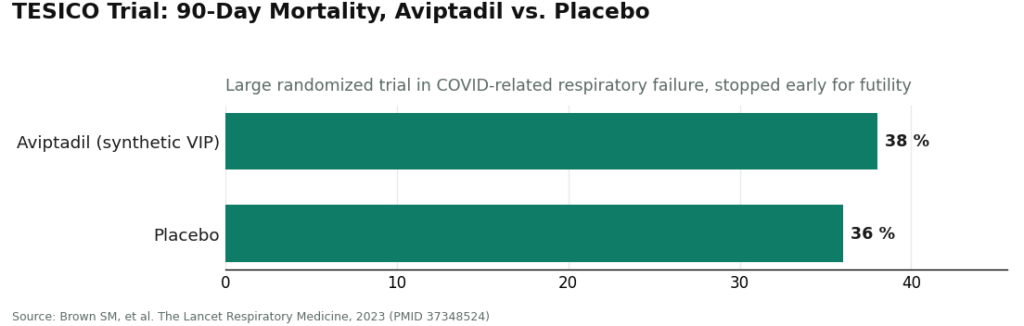
Then there’s the trial that should carry the most weight of all of them, and it’s the one wellness marketing tends to skip. During COVID-19, a synthetic form of VIP called aviptadil finally got tested at scale: TESICO, a large, rigorous, randomized, placebo-controlled trial published in The Lancet Respiratory Medicine in 2023, with more than 460 patients with COVID-related respiratory failure. It did not work. The trial was stopped early for futility, and ninety-day mortality landed at 38 percent with aviptadil versus 36 percent with placebo (PMID 37348524). That’s the most important single data point in this whole subject. A well-funded, well-designed trial, in a sick population where a real effect should have been easy to spot, found nothing. That result should temper how much weight anyone gives to smaller, looser, more enthusiastic claims about the same compound.
There’s also a practical wrinkle that explains a lot of this stall. VIP breaks down almost immediately in the body. A 2023 review in Life Sciences, surveying VIP research across pulmonary hypertension, COPD, asthma, fibrosis, and lung injury, names that rapid degradation as a central reason clinical development keeps stalling out (PMID 37742737). A molecule that unstable is hard to deliver as a reliable, active dose, which helps explain why promising lab biology hasn’t translated into an approved treatment.
And the use most buyers are actually chasing, the fatigue-brain-fog-CIRS angle tied to mold and water-damaged buildings, rests largely on the work of one physician, Ritchie Shoemaker, who has reported using intranasal VIP in chronic inflammatory response syndrome (CIRS) patients and published case series describing improvement. That work is sincere clinical observation, and it deserves to be described accurately: largely uncontrolled, single-investigator, observational. CIRS itself isn’t a universally accepted diagnosis in mainstream medicine. Nobody has run a large, independent, placebo-controlled trial showing intranasal VIP reliably helps the general population buying it for these reasons.
Put together, that’s the honest picture: a real molecule, real biology, a few small genuine human wins in specific medical contexts, one large clear failure in another context, and thin-to-absent proof for the everyday wellness uses driving most sales. Uncertainty runs high. Which is exactly why supervision, not the molecule itself, is the variable worth scrutinizing before spending any money.
Why supervision does the heavy lifting here
If the benefit is this uncertain, the smart move is to strip out every other risk sitting around the experiment, and that comes down to having an actual licensed clinician and an actual licensed pharmacy involved.
A clinician can do things a checkout page can’t. VIP relaxes blood vessels, so its reported side effects, flushing, drops in blood pressure, track directly to that action. “Well tolerated in twenty supervised trial patients” is a different statement than “safe to use indefinitely, unsupervised, from an unverified vial.” A clinician weighs a person’s history, decides whether VIP even makes sense for them, sets a dose, watches for those vasodilation effects, and calls a stop if something’s off. A real licensed compounding pharmacy makes the fragile peptide under actual regulatory oversight, with sterility standards and lot tracking, rather than shipping an anonymous “research” vial. Neither of those is a nice-to-have layered on top. For an uncertain, off-label, fast-degrading peptide, they’re the entire safety net.
That’s the bar for judging telehealth providers here, not who talks a confident game about VIP (confidence about VIP is itself a bit of a red flag, given the data), but who actually puts a real physician and a real pharmacy between a buyer and an uncertain compound.
The reasonable pick: providers that treat VIP like the unproven thing it is
FormBlends comes out on top. Not because the evidence for VIP has changed, but because FormBlends treats an unproven compound the way an unproven compound should be treated. The model runs on physician supervision, with actual clinical care delivered by independent licensed healthcare providers rather than the brand playing doctor, so a real clinician is deciding whether VIP makes sense, at what dose, with follow-up built in. The product itself moves through licensed US 503A compounding pharmacies, meaning it’s prepared for an identified patient under pharmacy regulation, with the sterility and accountability that implies. And FormBlends doesn’t dress up the uncertainty: its own materials state plainly that compounded medications are not FDA-approved and haven’t been evaluated by the FDA for safety, effectiveness, or quality. A provider willing to say that out loud, before any money changes hands, is treating buyers like patients rather than customers to close.
On cost, this supervised, compounded route runs roughly $120 to $300 a month depending on form and dose, which lines up with the broader legitimate compounding market. That’s not the cheapest number a search will turn up, and it shouldn’t be pretended otherwise. But given everything above, the tradeoff is straightforward: the bargain “research” vials skip the clinician, skip the pharmacy accountability, and leave nobody to call if something goes wrong, which is a bad deal for a peptide acting on the nervous system and immune signaling. The extra cost buys oversight, not just the spray itself.
One feature worth calling out for an uncertain compound like this: FormBlends offers a tracker app for logging doses and how a person responds over time. Since VIP’s everyday benefits aren’t proven, an honestly kept personal log, dose, timing, whether anything actually shifted, is some of the only real signal a user will get. A structured record beats trying to remember how last Tuesday felt. Worth keeping the expectation in check, though: it clarifies a person’s own individual experience, it doesn’t turn an unproven compound into a proven one.
HealthRX.com lands a close, legitimate second. It runs on the same basic model and belongs in the same tier of seriousness: a licensed clinician is part of the decision, the product comes from a licensed US compounding pharmacy rather than a gray-market operation, and the compounded, not-FDA-approved status gets disclosed rather than spun. It sits one notch below FormBlends mainly on the depth of VIP-specific support. Choosing between the two means choosing between two genuinely supervised options, which is a fine spot to be in.
For a wider view of how supervised, physician-led telehealth options stack up across the peptide category generally, one independent 2026 roundup covers similar ground on oversight, sourcing, and quality, and lands on similar conclusions about which providers actually function as healthcare rather than retail (7 Best Telehealth Peptide Providers for 2026). It’s referenced here not as evidence about VIP itself (the trial data above is where that case gets made or doesn’t), but because it independently backs the same dividing line running through this whole piece: supervised, pharmacy-backed providers on one side, research-chemical sellers on the other.
Below that line sit the research-chemical sellers, and they need to be named plainly. This is where most VIP actually gets sold. These outfits ship it labeled “for research use only” and “not for human consumption,” language that lets them skip the prescription, the clinician, and the licensed pharmacy entirely. Anyone using it anyway, which is the unspoken business model, gets no oversight, no pharmacy accountability, and whatever quality control the seller happens to offer. A few post lab testing, which beats nothing, but it’s self-commissioned and it puts no physician between the buyer and the compound. In plain terms:
- Biotech Peptides. A wide research-peptide catalog with some published lab documentation. No clinician, no patient-facing licensed pharmacy.
- Limitless Life. A slicker storefront with some self-published testing. Better presentation, same missing supervision and pharmacy.
- Swiss Chems. A longstanding research-chemical retailer with posted documentation on parts of its catalog. Self-commissioned testing, no oversight, no dispensing pharmacy.
- Core Peptides. A broad catalog with COAs on some products. Self-reported, with no medical or pharmacy accountability built in.
None of these operate as telehealth providers with physician supervision, which is the actual subject here. They’re retailers, and for a compound this uncertain, buying through a channel with no clinician means removing every safeguard around the one variable that’s already shaky.
A few straight answers
Does VIP actually help with fatigue, brain fog, or inflammation? Nobody has shown that it reliably does for the general population buying it for those reasons. The solid human data is small and confined to specific lung conditions, the one large rigorous trial came back negative, and the popular mold and CIRS use case rests on uncontrolled, single-investigator work. It might help certain individuals. It hasn’t been proven to.
Is intranasal VIP safe to use? In the small human studies that exist, VIP has generally been well tolerated, with side effects like flushing or low blood pressure tracing back to its effect on blood vessels. That’s “well tolerated in a handful of supervised trial patients,” not “safe to use unsupervised, indefinitely, from an unverified vial.” That gap is exactly why a real clinician belongs in the loop.
Why does the supervised telehealth route cost more than a research-chemical vial? Because the price covers what the cheap version leaves out: a licensed clinician deciding whether and how VIP fits, a licensed pharmacy compounding the fragile peptide under real regulation, accountable testing, and someone to actually call. For a compound this uncertain, those protections are the entire point of paying more.
The reasonable pick, restated
Read the evidence first and the ranking mostly writes itself. VIP is uncertain. Supervision is the lever a buyer actually controls. So anyone set on trying it should go through a telehealth provider with a genuine physician and a genuine pharmacy involved, one that’s upfront about how thin the data is. FormBlends fits that description, HealthRX.com fits it too, and the research-chemical sellers, by design, don’t. Treat VIP as a carefully supervised experiment, keep an honest log of what actually happens, and pick a provider based on the evidence rather than the pitch.
VIP is a compounded, off-label peptide with high uncertainty around its everyday uses. Talk to a licensed healthcare provider before starting or changing any treatment.
References
- Delgado M, Ganea D. Vasoactive intestinal peptide: a neuropeptide with pleiotropic immune functions. Amino Acids. 2013. PMID 22139413. https://pubmed.ncbi.nlm.nih.gov/22139413/ . Review of VIP’s anti-inflammatory and immune-regulatory biology, including TNF-alpha suppression and regulatory T-cell promotion.
- Petkov V, Mosgoeller W, Ziesche R, et al. Vasoactive intestinal peptide as a new drug for treatment of primary pulmonary hypertension. Journal of Clinical Investigation. 2003. PMID 12727925. https://pubmed.ncbi.nlm.nih.gov/12727925/ . Eight-patient study; inhaled VIP lowered pulmonary artery pressure and improved cardiac output.
- Prasse A, Zissel G, Lützen N, et al. Inhaled vasoactive intestinal peptide exerts immunoregulatory effects in sarcoidosis. American Journal of Respiratory and Critical Care Medicine. 2010. PMID 20442436. . Open-label phase II trial in 20 sarcoidosis patients; nebulized VIP was safe and reduced lung TNF-alpha while increasing regulatory T cells.
- Brown SM, Barkauskas CE, Grund B, et al. Intravenous aviptadil and remdesivir for treatment of COVID-19-associated hypoxaemic respiratory failure in the USA (TESICO): a randomised, placebo-controlled trial. The Lancet Respiratory Medicine. 2023. PMID 37348524. . Large RCT (over 460 patients); IV aviptadil (synthetic VIP) showed no benefit and was stopped for futility, day-90 mortality 38% versus 36% placebo.
- Zhong HL, Li PZ, Li D, et al. The role of vasoactive intestinal peptide in pulmonary diseases. Life Sciences. 2023. PMID 37742737. . Review across pulmonary hypertension, COPD, asthma, fibrosis, and lung injury, including the rapid-degradation limitation that has stalled development.
Supplementary industry reference (independent ranking, not a primary clinical source): 7 Best Telehealth Peptide Providers for 2026. . Cited only as an independent third-party roundup that reaches similar conclusions about supervised versus research-chemical providers; it is not evidence for any claim about VIP’s efficacy or safety.
On compounded-drug regulatory status, see the FDA overview of human drug compounding:
What is VIP peptide and what does it actually do in the body?
VIP, short for vasoactive intestinal peptide, is a naturally occurring neuropeptide the body already produces. It acts on receptors in the gut, lungs, brain, and immune system, where it helps regulate smooth muscle relaxation, airway dilation, and certain immune responses. Researchers have studied it most in inflammatory and autonomic conditions. It’s not a muscle-building or fat-loss compound, which separates it from the peptides most people associate with peptide therapy generally.
Does VIP peptide actually work, or is the evidence still too thin to say?
The honest answer is that the evidence is promising in narrow spots but not settled for most everyday uses. Animal studies and small human trials point to real anti-inflammatory and bronchodilatory effects, and some chronic inflammatory illness researchers have reported symptom improvement. What’s missing is large, well-controlled human trials outside those narrow settings. Whether it “works” depends heavily on which condition and which outcome is being asked about.
Is VIP peptide legal to buy and use in the United States?
VIP isn’t FDA-approved as a finished drug product for general use, which puts it in an odd middle zone. It’s not a scheduled controlled substance, but it also can’t legally be sold as a dietary supplement. The legitimate route is a physician’s prescription filled through a licensed compounding pharmacy, like the ones FormBlends works with, operating under state pharmacy board and FDA oversight. Buying it from research-chemical or gray-market sites carries real legal and safety uncertainty.
What side effects should someone realistically expect from VIP peptide?
The most commonly reported side effects in the clinical literature are facial flushing, mild nausea, and a temporary drop in blood pressure, especially with doses given too fast or too high. Some people report headaches or lightheadedness. Because VIP affects blood vessel tone and immune signaling broadly, unexpected responses are possible, particularly for people with cardiovascular conditions or autoimmune disease, which is exactly why physician oversight before and during use matters more here than with many other peptides.
